


-popup_image.jpg)




Here’s a fact that will freeze the blood of all beer lovers: there are now more vineyards in Kent than hop farms.
Since the 16th century, the county of Kent has been at the heart of hop growing. It has what the French call terroir – the right balance of soil, sunshine and rain to grow the finest hops.
The soil in the Garden of England is sandy and loamy. This means it retains rain and moisture and enables the hops to grow fast and develop the piny, spicy and peppery aromas and flavours for which English hops are famous.
The decline in hop growing has been calamitous, not only in Kent but in other major cultivation areas such as Hereford and Worcester. In 1962 8,200 hectares were devoted to hop growing. By the end of the century the number had fallen to 1,060 with just 45 hop farms left.
The reason for the decline is due to the dominance of global lager brewers plus smaller craft producers preferring New World hops from the United States and Australasia. In 2024 1,800 tons of American hops were imported, undermining the efforts of English growers.
AB InBev, Carlsberg, Heineken and Molson Coors, which produce some 90 per cent of all the beer produced and consumed in the UK, don’t want the powerful flavours of English hops in their bland products. They prefer the more restrained character of European hops, especially the so-called noble varieties from the world’s biggest hop-growing region, the Bavarian Hallertau.
To add to the woes of English hop farmers, they were dealt a body blow in 2009 when DEFRA, the government’s Department for the Environment, Food and Rural Affairs, withdrew funding from Wye College in Kent. The college had been a centre for agricultural research from the 19th century and was at the forefront of breeding new varieties of hops.
Since the 1980s, the college, led by Dr Peter Darby, had concentrated on developing hops that were environmentally friendly – using less pesticide and fertiliser – and were disease-resistant.
The college’s research led to the first hedgerow variety, First Gold, which sparked a revolution in hop growing around the world.
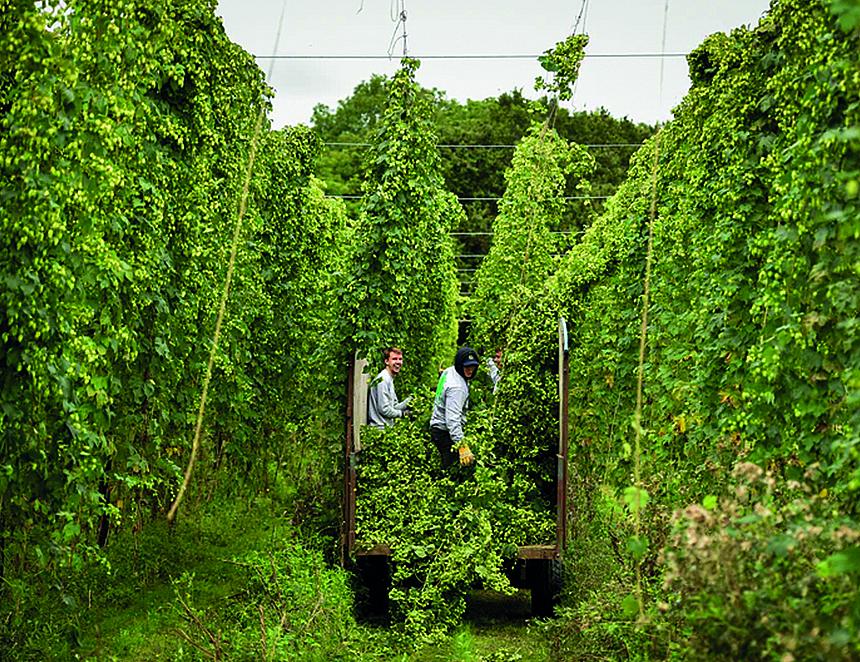
Conventional hops grow to more than 20 feet in height. As the name implies, hedgerow or low-trellis hops are half that height. As a result, they are easier and cheaper to harvest and less prone to attack by pests that can munch their way through whole fields of hops in a few days.
The closure of Wye College sparked fury in the hop-farming community and led to a major fightback to promote its products. The virtually moribund National Hop Association was transformed into the British Hop Association by new, younger and determined farmers. They were led by Alison Capper who, with her husband Richard, grows hops in abundance at Stocks Farm on the Hereford and Worcester border.
Ali Capper is the director of the BHA and, with her fellow directors, set up a subsidiary Wye Hops that enabled Peter Darby to continue his breeding programme.
Dr Darby also built the English Hop Collection in Kent with the support of local brewer Shepherd Neame. The collection at Queen’s Court, which is open to visitors, houses 70 historic English hop varieties that stress the great contribution they have made over the centuries to the unique character of British beer.
The good news is that the campaign to revive English hops is flourishing. In 1998 there were just 13 varieties of domestic hops. That has increased to an impressive 34 grown by 45 farmers.
Wye Hops has been joined by Charles Faram, Britain’s leading hop merchant based in Worcester. Faram has been operating for 160 years and grows and trials new varieties on its own farms.
It takes 10 years to develop a new variety, crossbreeding from existing hops. Faram has responded to current demand with varieties that offer the citrus/grapefruit and tropical fruit aromas and flavours that many craft brewers and drinkers seek.
Faram has had great success with Jester that offers grapefruit, pine and blackcurrant notes. Other popular new hops include Emperor, Godiva, Olicana, Opus and Endeavour, the last named in honour of the fictional Inspector E for Endeavour Morse, who was known to enjoy a pint or three.
A hop called Ernest is a revival of a variety first grown in the 1950s but abandoned then as brewers said its flavours were too “catty” – a characteristic now back in fashion.
Important work is being undertaken at Wye Hops. Peter Darby has retired and his successor, Klara Hadju, is working with Kent University’s School of Biosciences to develop new hop varieties that are resilient to drought and disease.
The collaboration is backed by the BHA with the help of a £500,000 donation by UK Research and Innovation that is funded by the government’s Department of Science, Innovation and Technology.
Brewers are also making a contribution to the revival of English hops. Harvey’s of Lewes in East Sussex has hops contract grown by farmers in the county.
Shepherd Neame, Britain's oldest brewer dating from 1698 and based in Faversham in Kent, not surprisingly uses such traditional English hops as Fuggles and Goldings in its beers. Many family brewers remain committed to using English varieties.
A major contribution has come from Hogs Back brewery in Surrey. In 2014 owner Rupert Thompson planted his own hop field alongside the brewery in Tongham. As well as modern varieties suitable for his beers and lager, he has revived a local hop, the Farnham White Bine, once a major variety in the region and the precursor of the much-prized Golding. Rupert discovered that a farm in Surrey, where White Bine had been grown, had kept some seedlings that he planted and brought back to life.
The hop farm (pictured) has been a big success and a visitor attraction and has been extended to 8.5 acres. The hop varieties include an English version of the American Cascade along with traditional Fuggles and Goldings.
The case for using local hops is overwhelming. Importing the plants from the U.S. and as far away as New Zealand is bad for the environment, creating thousands of food miles.
If a tenth of imported American hops were replaced by local plants the hop acreage in this country would double.
So, dig up those vineyards and start planting.