










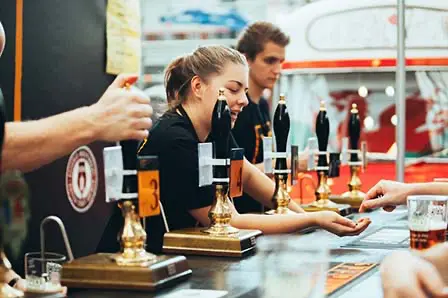

The levelling up of brewing science is a constant source of fascination for me. I talked about hop extracts in this column last year. Before that, I was getting to grips with how thiols were being used to unlock new levels of fruit flavours and aromas. A visit to the SIBA trade show, BeerX, is always an opportunity for me to make new (well, new to me) discoveries about what the next avenue of flavour exploration is yielding.
This year, it was flavour derived from yeast that caught my attention. This is not a novel concept, of course. I’m sure most readers will be familiar with the ester characters that are fundamental to beer styles like Bavarian wheat or Belgian dubbel. The aromas of banana, bubblegum or clove might be drifting through your sense memory as you read this.
What I saw at BeerX was different. I found a product, made from yeast, which offered the sort of flavour profiles that would more typically be associated with aroma hops.
The idea that yeast could provide fruity tones to beer – beyond banana or pear drop – was first introduced to me on a visit to Amsterdam at the end of 2024. I was guided around the full spectacle of the Heineken Experience and the brewing process was explained to me.
I have heard the method of brewing beer explained on the odd occasion before, as it happens, but you can never do too many brewery tours. They’re all different and, every now and again, something interesting will jump out.
At Heineken, I was baffled as to why the tour guide was giving us the in-depth view on its malt and the hallowed Heineken-A yeast, but nobody was talking about hops. At all. I even asked the question explicitly: what hops do you use? The tour guide didn’t know. Neither did the colleague that she ran off to ask. It was only when I (luckily) found myself in the company of global master brewer Willem Van Waeberghe, that I discovered the answer.
The answer was, it doesn’t matter. In the Netherlands, Heineken sources hops from the US, but its licensed brewers around the world can source whatever they want. All the hops are added at the start of the boil for bitterness only. They never have a second hop addition. All of Heineken’s flavour, which is perhaps a little fruity, a touch herbaceous with just the tiniest note of aniseed, comes from the yeast esters.
That is why Heineken-A yeast is described as the soul of the company. A licensed brewer can do what it likes for hops, but the yeast strain must be carefully managed and completely unadulterated to ensure the beer tastes the same wherever in the world you drink it.
I was fascinated. I had no idea. I’d certainly not been able to tell from the taste. Heineken is a yeast-forward lager – the only macro lager of its kind in this regard, as far as I can tell. But in Liverpool, yeast had more surprises waiting for me. This time it was not esters that were on display, but terpenes.
A Danish company, Evodia, has teamed up with Lallemand Brewing to create the quaintly named Yops – an “aroma solution” derived from a patented yeast fermentation process that provides really bright profiles of grapefruit, pine, mandarin and more from terpenes.
Now, hops are full of terpenes, which is why we are already familiar with these kinds of herbal and fruity flavours in our beer. The limitation is that the intensity of the brewing process is not kind to these delicate molecules. That’s why punchier flavoured beers are dry hopped as you need to add more hops and treat them more gently to get bolder flavour out.
Yops offer a way to add terpenes directly to a beer, in whatever level of intensity the brewer chooses, without the need for huge, expensive quantities of hops. Adding a clear liquid to the beer instead of more plant matter also makes things more efficient from a business perspective.
Hops aren’t made redundant by this innovation, of course. Their bittering qualities and the layers of aroma they offer still have a vital place. But Yops are another weapon in the brewer’s arsenal – a flavour boost.
Pretty cool, right?
Well, probably not cool for some of you. I have seen the creeping return of the “beer-flavoured beer or nothing” brigade recently and I know there are plenty of people out there who cannot stand a brew that tastes like grapefruit. That’s fine. Stand aside. There is a best bitter further down the bar drinking beautifully just now.
For those of us who like having the option of beer with boatloads of aromatic intensity, this is a fun development. It’s worth noting that the Yops range was initially developed to bolster the intensity of alcohol-free beers, so there are also ester-led options available. Since brewing to strength for low alcohol doesn’t allow those traditional characters to develop, this alternative has provided a credible pathway for better alcohol-free wheat beers, for example.
It won’t change the world. A certain proportion of brewers wouldn’t even consider using it. But it opens new avenues of experimentation for those that do and will doubtless have interesting results for those of us that enjoy the fruits of their labours.